How Growth Is a Subtraction Problem
How the best Strategic Growth functions turn Marketing and Sales signals into one cohesive product — and why disciplined "no" is the mechanism that makes it possible.
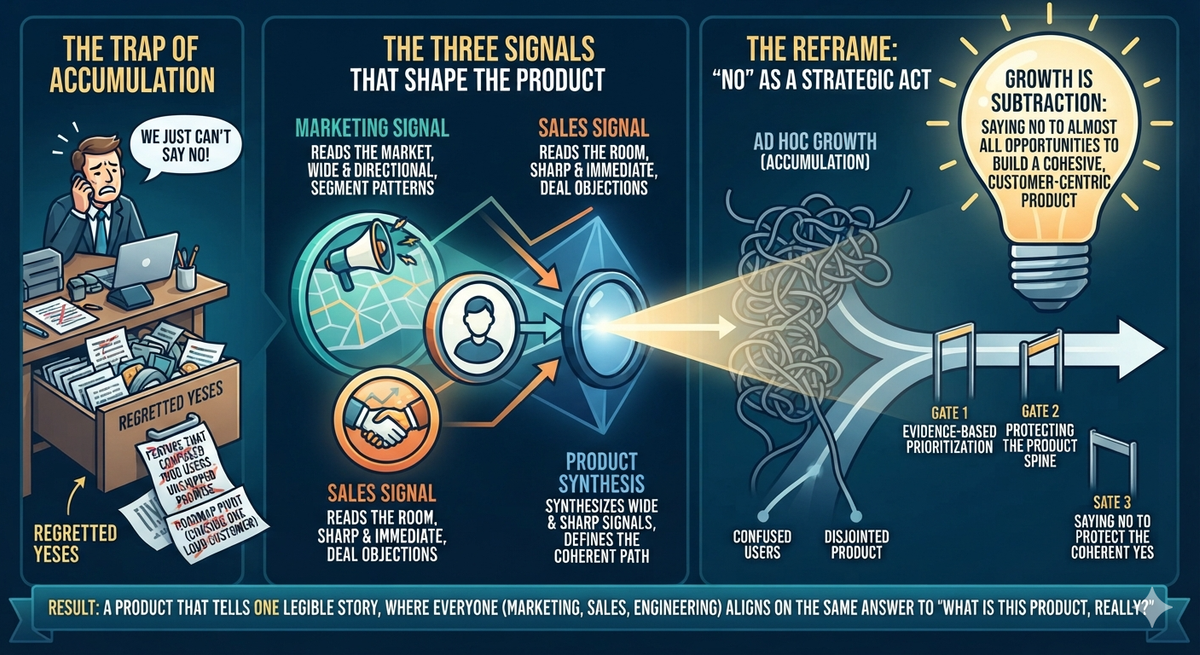
There's a quiet failure mode inside fast-growing companies. It doesn't look like failure. It looks like momentum.
The roadmap is full. Every quarter ships something. Sales is bringing requests, Marketing is bringing campaigns, and Product is heads-down delivering. From a distance, it reads as a healthy, busy team.
Look closer and you find a product that's become a collection of features instead of a coherent whole — each one added to close a deal, win a segment, or answer a competitor, none of them adding up to a clear answer about what the product actually is. This is what happens when a growth organization loses the ability to say no.
This piece is about rebuilding that ability: why "no" is the most strategic word in a growth leader's vocabulary, how Marketing, Sales, and Product should feed a single strategy rather than compete for one, and how to protect focus without damaging the relationships that growth depends on.
Why Growth Is a Subtraction Problem
Most teams treat growth as accumulation. More features to sell, more segments to enter, more channels to run, more pipeline to chase. Growth becomes a synonym for more.
The products that compound over time tend to work the opposite way. They have a spine — a clear, defensible point of view about who they serve and, just as importantly, who they don't. That spine is what lets a product get sharper as it scales instead of muddier.
A spine is expensive to maintain. Every quarter, dozens of reasonable requests arrive that would bend it slightly out of shape. Each one, taken alone, is defensible. Taken together, they're how a focused product becomes a generic one. Protecting the spine means saying no to the majority of good ideas so the great ones have room to matter.
That is the real work of strategic growth: not choosing between good and bad, but choosing among competing goods, and having the discipline to decline most of them.
The Three Signals That Should Shape a Cohesive Product
Strategic growth fails when Marketing, Sales, and Product operate as three separate intake queues, each escalating its own priorities and each measuring success by how many of its requests got built.
It succeeds when those three functions are understood as three different sensors pointed at the same thing: the customer. Each sees something the others can't. None of them sees the whole picture alone.
Marketing Reads the Market
Marketing operates at the altitude of segments and categories. It sees positioning gaps, shifts in buyer language, emerging needs before they're fully articulated, and where the product sits in a customer's mind relative to alternatives. Marketing's signal is wide and directional — it tells you where the market is moving, not exactly what to build next.
Sales Reads the Room
Sales operates at the altitude of the individual deal. It hears the specific objection that stalled a close, the feature a prospect named as a dealbreaker, the competitor that keeps appearing in the final round, the workflow gap that made a champion hesitate. Sales' signal is sharp, concrete, and immediate — but it's also biased toward the deal in front of it, which may or may not represent a durable pattern.
Product Reads Both — and Decides
Product's job is not to average these inputs, and it's certainly not to serve whichever function is loudest this week. It's to synthesize the wide signal from Marketing and the sharp signal from Sales into a coherent decision about what the product should become.
The synthesis is where value is created. A single Sales request is an anecdote. The same request echoed across a segment that Marketing has independently flagged is a pattern worth building for. A Marketing thesis about the market means little until Sales can confirm buyers will actually pay for it. The two signals validate and sharpen each other — but only if someone is holding both at once.
When all three functions feed one strategy, the question changes. "Can we build X?" becomes "What customer need does X point to, and is that need on the path we've committed to?" That reframe is the foundation of every good no.
Reframing "No" as a Strategic Act
A no delivered as a flat refusal is a rejection. A no delivered as a consequence of strategy is a decision. The words can be identical; the meaning is entirely different.
When a growth leader says no to a feature request, the honest translation is rarely "that's a bad idea." It's usually one of:
- That need is real, but it belongs to a customer we haven't chosen to serve.
- That need is real and ours, but it's behind three things that matter more right now.
- That's a solution to a problem we're already solving a better way.
- We don't yet have evidence this is a pattern rather than a single deal.
Each of these is a strategic position, not a personal verdict. The skill of saying no well is largely the skill of making that underlying reasoning visible, so the person hearing "no" understands they're colliding with a strategy rather than an ego.
Five Ways to Say No Without Burning the Bridge
The relationships matter enormously. A Sales team that stops surfacing deal intelligence because it feels ignored has just blinded your sharpest sensor. A Marketing team that stops sharing market signal because its input never lands has blinded your widest one. The goal is never simply to decline — it's to decline in a way that keeps the signal flowing.
1. Say No to the Request, Yes to the Need
Almost every request is a proposed solution wrapped around a real problem. Reject the solution, honor the problem. "We're not going to build that specific integration, but the need underneath it — getting data into your workflow without manual export — is real, and here's how we intend to serve it." People will accept a no to their solution far more readily than a no to their problem.
2. Make the Trade-off Visible
A no in isolation reads as a veto. A no with its cost attached reads as a shared decision. "Saying yes to this means pulling the team off the onboarding work that's driving our retention numbers" turns a unilateral call into a transparent trade-off. Show the board you're looking at. Let people weigh what you're weighing.
3. Anchor the No to Strategy, Not Opinion
If the answer is "that's not who we've committed to building for this quarter," the disagreement stops being you versus them and becomes the request versus the strategy. That's a far more productive argument — and if the strategy is wrong, it's the right thing to be arguing about anyway.
4. Offer "Not Now" With a Condition, Not a Wall
The most durable no is often a "not yet" with an explicit door. "Here's what would have to be true for this to move up the roadmap" converts a dead end into a criterion. Now Sales can go validate the pattern; Marketing can go test the segment. The people you told no are suddenly working with you to build the case, instead of routing around you to an executive.
5. Bring the Evidence
A no backed by customer data, usage patterns, or a clear strategic rationale lands and holds. A no backed by instinct invites escalation. The discipline of grounding decisions in evidence does double duty: it makes your nos defensible, and it keeps your own judgment honest about which yeses deserve to survive.
Building the System, Not Just the Skill
Individual acts of tactful refusal only go so far. Durable focus comes from a shared process that makes prioritization legible to everyone before any single decision is made.
A few practices that turn saying no from a personality trait into an operating system:
A single intake path. When requests from Marketing and Sales flow through one visible, shared queue rather than a tangle of private conversations and executive side-channels, prioritization becomes a transparent exercise instead of a political one.
A published strategy and set of criteria. When the bar for "yes" is written down and known, most nos answer themselves. People can see why their request didn't clear it — and can build a stronger case next time.
Closed loops. Telling someone what you decided and why, especially when the answer was no, is what keeps them bringing you signal. Silence is how you train your best sensors to stop reporting.
Regular synthesis, not just intake. A recurring forum where Marketing's market view and Sales' deal view are reconciled against the roadmap turns three streams of requests into one coherent conversation about the customer.
Cohesion Is the Point
Every no in a healthy growth organization is in service of a single outcome: a product that tells one story.
When focus is protected, the whole system aligns. Marketing can position the product without stretching the truth, because the product genuinely is what the positioning claims. Sales can sell it without promising things that don't exist, because the roadmap is coherent enough to be trustworthy. Engineering can build without whiplash, because priorities don't reverse every time a loud deal appears. And the customer receives something that feels designed — an intentional whole — rather than a pile of features assembled from the loudest requests of the last two quarters.
That coherence is fragile. It survives only as long as someone is willing to protect it, request by request, with nos that are clear, kind, well-reasoned, and anchored to a strategy everyone can see.
The art of saying no, in the end, isn't about refusal at all. It's about protecting a yes worth keeping — and making sure that when a customer, a colleague, or a competitor asks what is this product, really?, there is a clear answer, and everyone building it, marketing it, and selling it gives the same one.
Explore Topics
Written by
Suman | humAIne
Content creator and writer sharing insights and stories.