Brand Is What Breaks the Resistance Nobody Names
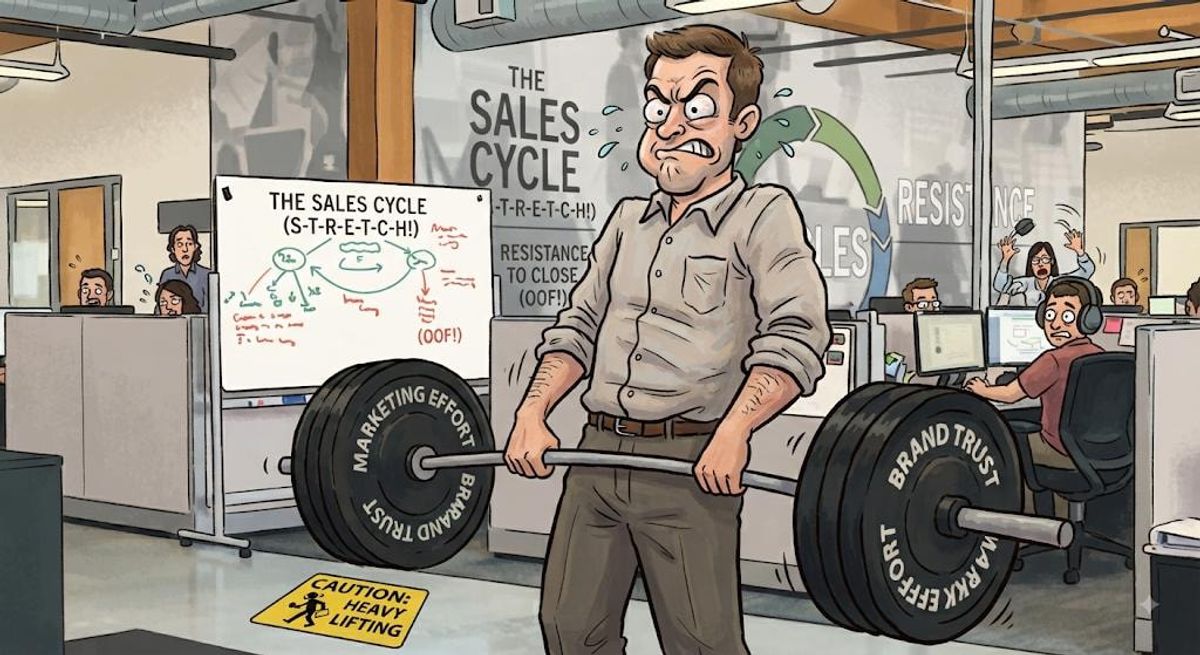
Sales lives in resistance. Every stalled email thread, every quiet no — that is the barbell. Marketing's job is to make that bar lighter before the salesperson ever picks it up. That is what brand actually is.
My friend called me yesterday, sore from his gym routine. Curious, I asked what he'd been doing — he's a yoga person, not a weights person.
He said his coach put him on resistance training. So he showed up, picked up a barbell, and asked the trainer: "Does resisting to lift the weight also count as resistance training?"
It's a fair question. Resistance shows up everywhere, disguised as effort. In the gym, it's the point — you're supposed to push against it. In business, it's rarely named. No one wants to hurt anyone's feelings by admitting they're pushing back.
That's exactly where marketing and sales part ways.
Sales Lives in Resistance
Every "let me think about it," every stalled email thread, every quiet no — that's the barbell. A salesperson has to earn trust in real time, against real friction, from a prospect who owes them nothing.
Marketing's job is to make that bar lighter before the salesperson ever picks it up.
That's what brand actually is. Not a logo. Not a tagline. The accumulated trust a company earns before a human being ever asks for it directly.
The Wrong Rep
Too many marketing teams measure the wrong rep. Page views. Registrations. Cost per lead. Those are activity metrics — they tell you the machine is running, not that anyone believes what it's saying. Chasing them is a distraction from the harder work: building a brand that earns loyalty, not just clicks.
AI has made this worse in one specific way. It's brilliant at optimizing the IQ of segmentation — who to target, when, with what message, at what spend. It has no opinion on the EQ of the relationship. It can't tell you whether the brand actually earned the trust the sales rep is about to spend.
Most marketing organizations have gotten very good at the IQ. Almost none have built discipline around the EQ.
Where the Gap Lives
The gap between those two is exactly where sales cycles get longer, win rates get softer, and CAC creeps up — not because the targeting was wrong, but because there was no trust banked before the ask.
Resistance training works because the resistance is honest — you can see the weight, feel it, measure it. Business resistance is quieter. It hides in "I need to check with my team" and "not the right time."
The companies that shorten sales cycles aren't the ones with the best segmentation. They're the ones whose brand did enough of the lifting before the sales conversation started.
The bar doesn't get lighter because you optimized your targeting. It gets lighter because you built something worth trusting before anyone asked.
Explore Topics
Written by
Suman | humAIne
Content creator and writer sharing insights and stories.