The Chariot Problem: Why Leadership Teams Exhaust Everyone and Still Don't Accelerate
Newton is filing a complaint if everyone is exhausted and nothing is accelerating. The board is the charioteer. The leadership team is the horses. The whip is quarterly returns. That mental model is wrong in one critical way — and understanding why changes how you lead.
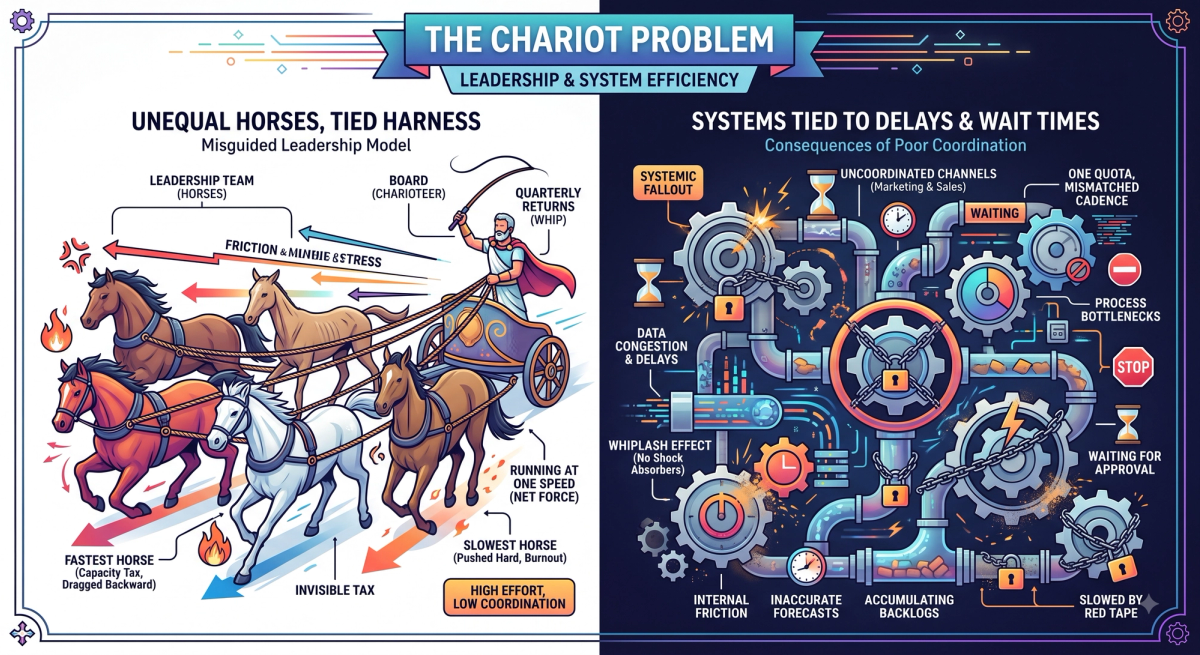
Newton is filing a complaint if everyone is exhausted and nothing is accelerating.
The board is the charioteer. The leadership team is the horses. The whip is quarterly returns.
That's the mental model most executives operate under. It's wrong in one critical way — and understanding why changes how you lead.
Six Horses, One Chariot
Picture six horses harnessed to a single chariot. Each one is running at their individual top speed. None of them is holding back.
But they're not moving at six different speeds. They're moving at one speed — because they're yoked together.
The fastest horse doesn't get to run at their pace. They get dragged backward by the other five. The slowest horse doesn't get to run at their pace either. They get dragged forward, past what they can sustain.
Every horse is at maximum effort. Every horse is running a speed that isn't their own.
The Charioteer Isn't Free Either
Here's the part most people miss: the charioteer doesn't control the chariot's speed. The chariot's speed is the average of six unequal forces — pull from the fast horses, drag from the slow ones.
The board asks for a number. The charioteer transmits that demand downward as the whip. But the vehicle only ever moves as fast as the net force allows. The charioteer is bound by the same physics as the horses — just with a different kind of pressure. Theirs is the pressure of being accountable for a speed they don't actually set.
This is the real picture of an executive team under performance pressure. Nobody in the system is coasting. Nobody is free. Everyone is straining against everyone else, and the person holding the reins is straining against a number that was fixed before the horses were even in harness.
Why This Matters for Leadership Teams
Three consequences follow directly from this model:
1. "Underperformance" is often a coordination problem, not an effort problem.
The slow horse isn't slow because they're not trying. They're slow relative to the harness. Diagnosing this as a talent or will problem — and whipping harder — burns out a horse that was already at max output.
2. Your fastest people are being taxed by your system, not just your slowest.
The fastest horse is losing capacity every day to the drag of the harness. That's invisible in most performance reviews, because on paper the team is "moving." But you're paying a hidden tax on your top talent, and it compounds — high performers who feel structurally capped leave first.
3. The charioteer's real job isn't whipping harder. It's re-harnessing.
You can't fix a variable-speed problem by increasing force on a fixed structure. You fix it by changing who's yoked to whom, adjusting the load each horse carries, or — in some cases — building parallel harnesses so speed differentials aren't fighting each other inside the same system.
Same Physics in Marketing and Sales
Marketing and sales are the most exposed harness in the company. They sit closest to the market's variable speed — demand shifts, channel performance shifts, competitor moves — and closest to the board's whip, because revenue is the number everyone watches first.
Run the same diagnostic:
The horses are your channels and motions, not your people. Paid, organic, outbound, partnerships, product-led growth — each has its own natural top speed. Force them into one harness with one shared quota and one shared cadence, and the fast channel gets throttled to match the slow one, while the slow channel gets whipped past what it can sustainably convert. That shows up as CAC creep and win-rate erosion — both at once, from the same root cause.
Whiplash is what happens when the harness has no shock absorption. A demand spike hits, sales pushes it straight through to fulfillment and CS with no buffer, and the system oscillates — overcorrection followed by overcorrection. That oscillation, not the demand spike itself, is what burns out reps and erodes trust in forecasts.
Customer centricity is what tells you how to harness, not just how to sell. Without it, you harness by internal convenience — org chart, quota structure, whoever complains loudest in QBRs. With it, you harness by the customer's actual buying motion, which tells you which channels should lead, which should follow, and where the natural gearing sits. Customer centricity isn't a values statement. It's the design input that keeps the harness from fighting itself.
The Actual Leadership Challenge
The tempting move is to read this as a story about the board being unreasonable. It isn't — and treating it that way is a dead end. The board's job is to ask for returns, the same way the horses' job is to run.
The harder and more useful read is this: harmony in a leadership team was never about getting everyone to the same speed. It's about designing the harness so unequal speeds produce forward motion instead of internal friction.
That's the job. Not whip management. Harness design.
System architecture and customer centricity are the two disciplines that make harness design possible — one tells you how the parts should connect, the other tells you which way they should pull. Together they're what separate a team that compounds from a team that whiplashes.
The fix was never more force on a fixed structure. It was always the architecture.
Explore Topics
Written by
Suman | humAIne
Content creator and writer sharing insights and stories.