Digital Transformation Isn't a Stack Problem. It's a Synchrony Problem
The companies that buy the most software often move the least. Why process, technology, and mindset — plus Customer, Employee, and Competition 360 — have to move in synchrony.
Listen:
Here is the odd thing about digital transformation. The more tools you install, the less transformed you feel.
That is not a joke. It is a business model.
A few years ago I sat with a sales leader who had just finished a "transformation." New CRM. New data lake. New AI pilot. New dashboard that glowed like a cockpit.
He opened the dashboard for me. Then he opened Slack. Then a spreadsheet. Then another spreadsheet that existed because the first spreadsheet disagreed with the dashboard.
"Where's the customer?" I asked.
He pointed at four screens.
Which is another way of saying: nowhere.
Kurt Vonnegut used to say you should start as close to the end as possible. So let's start at the end of most transformation programs:
They decorate complexity. They do not remove it.
And then leadership is confused why loyalty still drifts, employees still invent workarounds, and competitors still ship the experience you meant to build.
The story nobody wants on the slide
Digital transformation is sold as technology.
It is lived as process.
It survives — or dies — as mindset.
Miss one lane and the other two become expensive theater.
Miss process, and AI just automates confusion faster.
Miss technology, and humans become the integration layer (congratulations, your people are now middleware).
Miss mindset, and you get pilots, decks, and a sacred phrase called "phase 2."
The contradiction worth hanging on your wall:
Growth doesn't come from more tools.
Growth comes from fewer places the truth can hide.
Three lenses, one synchrony
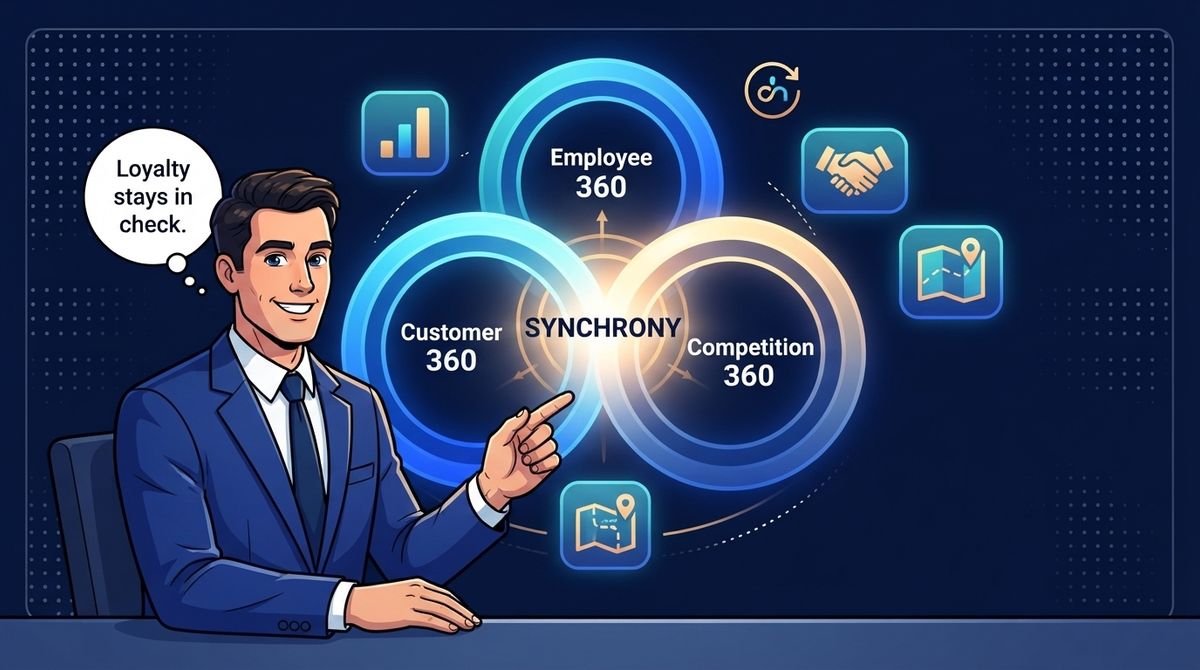
Customer 360 without Employee 360 is a beautiful insight nobody can act on.
Employee 360 without Competition 360 is internal excellence the market still outruns.
Competition 360 without Customer 360 is a feature race that never deepens loyalty.
So the real product is not a dashboard. The real product is synchrony — Customer 360, Employee 360, and Competition 360 protecting loyalty, speed, and margin.
When those three talk to each other, innovation becomes: pain → roadmap → prototype → proof → loyalty.
A Michael Lewis beat: the weakness nobody wanted to name
In every company there is a quiet room where the real transformation happens. It is not the war room with the roadmap poster.
It is the room where someone admits lost deals in the handoff, renewals dying in onboarding silence, and a "source of truth" that is actually a person.
Competition does not need to out-innovate you. It only needs to exploit the weakness you keep calling temporary. Temporary is the most expensive word in B2B.
The journey, without the theater
1. Map weakness before you buy software
Interview the last 20 lost deals, escalations, and support loops. Rank by revenue and emotional intensity.
2. Connect one journey end-to-end
Pick quote-to-cash, onboarding, renewal, or service recovery. Make it measurable across teams.
3. Build a minimum viable Customer 360 for that journey
Unify the fields people actually use. Kill duplicate sources.
4. Redesign employee workflow around that truth
If people still copy-paste between systems, your 360 is a costume.
5. Install a competition pulse
Track how fast competitors close the same pains you just mapped.
6. Prototype value before you industrialize architecture
In a Gen AI world, waiting for perfect architecture while the market moves is a tax on loyalty.
What leaders actually buy
Nobody wakes up craving another platform. They buy outcomes: loyalty up, pipeline faster, cost-to-serve down, roadmaps that retire named pain.
At humAIne, that's the work: turning B2B complexity into intelligent, measurable growth.
Closing (Vonnegut would approve)
So it goes: Digital transformation is not a launch event. It is continuous evaluation of weakness — before competition files the patent on your blind spot.
The stack got smarter.
The company did not.
Until synchrony.
Next: Growth is a continuous evaluation of weakness before competition exploits it.
About the author
Suman Vadlakonda leads humAIne — AI strategy and fractional C-suite consulting for B2B organizations. Want this applied to your stack? Book a discovery call at https://www.humaineglobal.com